
January 28, 2026 | Wednesday
Report on Situation Testing on Discrimination in the Employment Process
In December 2025, QKSGJ (Kosovo’s Center for Gender Studies) and IKS (Kosovo Initiative for Stability) launched the findings of the EU-funded research under the title Bias at the Doorstep: Unveiling Discrimination Through Labour Market Situation Testing, a study that sheds light on the earliest and least visible stages of recruitment, where discrimination and exclusion most often begin.
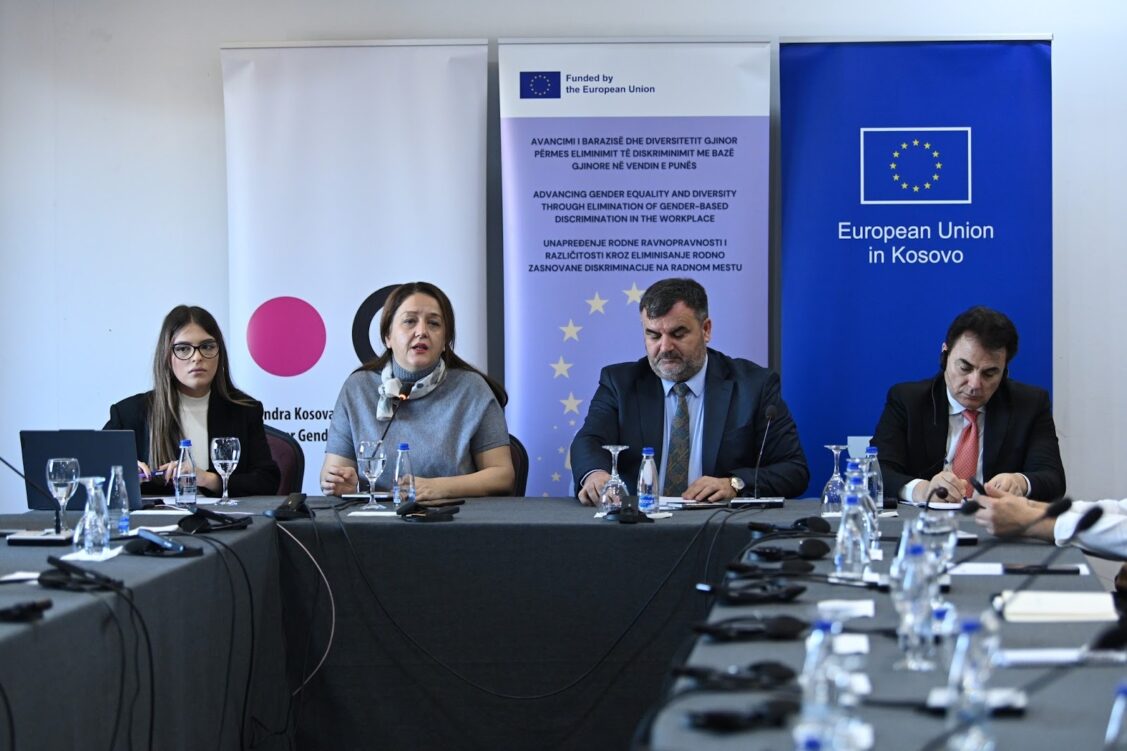
The EU-funded study used situation testing to examine how equally qualified job applicants are treated differently based solely on characteristics such as gender, ethnicity, or sexual orientation and gender identity. By focusing on application screening, call-backs, and interviews – employment process steps that rarely leave formal traces or lead to complaints, the study exposes how discrimination operates quietly at the “doorstep” of employment, defining how certain categories access the labour market long before a job contract is ever signed.
Unlike complaint-based monitoring, which captures only a small fraction of cases that escalate into formal disputes, situation testing reveals what usually remains invisible: everyday decisions, behaviours, and micro-interactions that shape access to work long before an employment relationship is formed.
Conducted between 13 and 30 November, 2025, the research included 18 companies and 25 job positions across different fields such as hospitality, logistics, administration, and cleaning service to expose the bias in the recruitment and labour market. Matched applicant profiles were submitted to publicly advertised vacancies using controlled application processes. To preserve methodological integrity, higher-level professional roles were excluded, ensuring that refusals could not be attributed to unclear expertise requirements but rather to differential treatment. Profiles varied only in one protected characteristic, allowing for a direct comparison of employer responses.
Even within the limited scope of this pilot, the findings reveal consistent patterns of unequal treatment. Kosovo Roma women faced some of the most visible barriers during interviews, including repeated questioning of their education, heightened concern over transportation, and lower salary offers. In one illustrative case, a Roma woman with stronger qualifications was not offered the position and was redirected to a job location outside Pristina. In contrast, a less-qualified non-Roma applicant for the same role was immediately offered employment in the city centre, with no logistical concerns raised.
Discrimination based on sexual orientation emerged most clearly among male applicants. Heterosexual men received faster responses and more concrete job offers, while gay men often experienced longer interviews that did not translate into equivalent opportunities. Among women, differential treatment was less overt and appeared more closely linked to gender expression than to sexual orientation alone, suggesting that conformity to stereotypical gender norms can influence employer perceptions.
Gender-based disparities were also evident across sectors. Male candidates were more frequently guided toward higher-paid or more responsible roles, while women were steered toward lower-status positions. In some cases, female applicants were asked intrusive questions unrelated to professional capacity, such as whether their family would “allow” them to work. Male candidates were never asked this set of questions.
Beyond individual cases, the study uncovered structural weaknesses in recruitment practices. Many companies did not respond to applications at all, while those that did often bypassed formal application channels, relying instead on phone calls or messaging applications. These informal practices reduce transparency, amplify subjective decision-making, and create fertile ground for discriminatory filtering.
Through support to initiatives like this study, the EU shows its commitment to remain a strong advocate of equal rights in the labour market. The findings of Bias at the Doorstep are addressed to government institutions, the Ombudsperson Institution, the Labour Inspectorate, civil society organisations, and the private sector. By illuminating what happens at the first gateway to work, this study seeks to contribute to a more transparent, accountable, and inclusive labour market in Kosovo.