
November 12, 2025 | Wednesday
At the age of 11 — as a child of the 1990s, amid the political turmoil and massive protests of professors and students calling for the reinstatement of education in the Albanian language under an increasingly repressive regime — Ervina Halili wrote her first poem, “Crowd 97” . In 2015, her third poetry book, “Amuletë” (“Amulet”) — which followed “Vinidra” (2008) and “Trëndafili i heshtjes” (“The Rose of Silence,” 2004) — was awarded the National Poetry Prize.
Halili is the founder of the digital museum/archive Rilindja, which reflects the contributions of Kosovo journalists to the newspaper of the same name (1945–1991). Her book “Gjumi i Oktapodit” (“Octopus’ Slumber”) was translated into German in a bilingual edition, while her first novel “Mali i Qumështit” (“The Mountain of Milk”) was published in 2025 by Onufri in Tirana. In 2021, she received the Democracy Award from the Kosovo Foundation for Open Society for her work in preserving the Rilindja archive.
She has led three creative writing workshops at the Europe House in Prishtina. We spoke with her to learn more about her writing practice and the intricate interweaving of creative writing as an inward and individual journey that strives to communicate universally. In this interview, Halili shares her experiences and explains how she has shared her knowledge and skills—drawing from those experiences—with participants of the creative writing workshops at the Europe House in Prishtina.
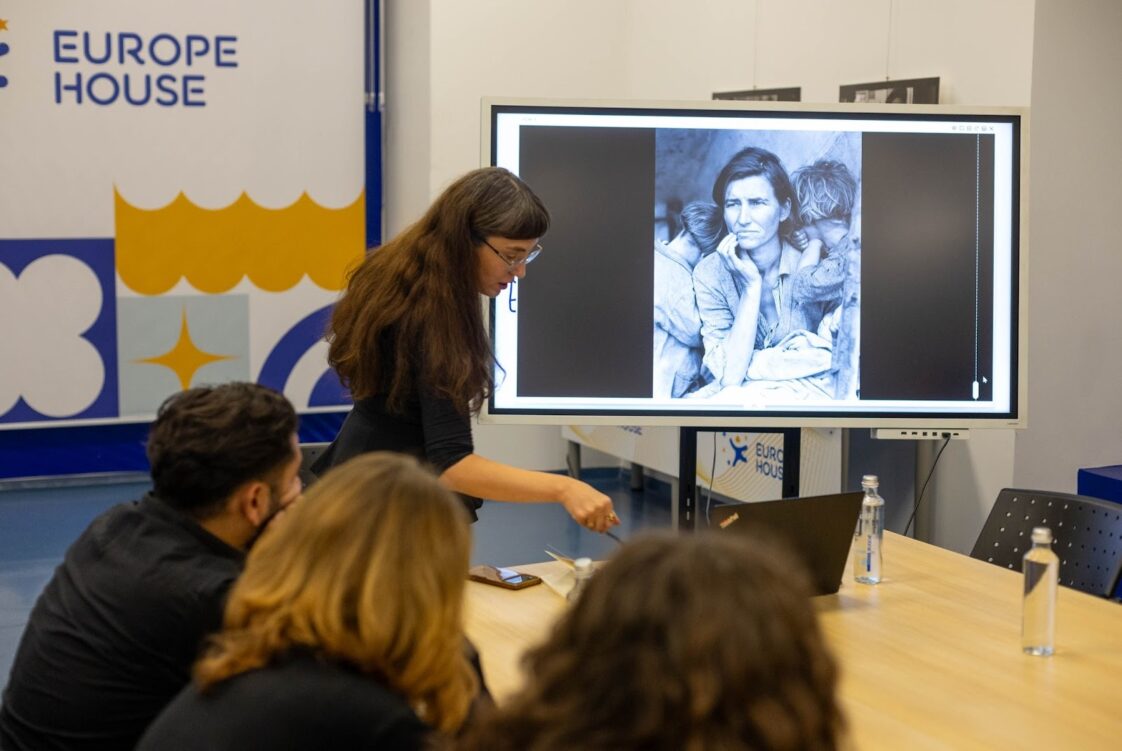
Europe House Kosovo: Throughout the three creative writing workshops at the Europe House in Prishtina, you guided the participants on a journey exploring writing practices. This exploration surely does not concern only the methods and techniques of writing, but more the discovery of themes and impulses that make creative articulation necessary. What was this process like for you?
Ervina Halili: The three sessions of the creative writing workshop, focused on the short story genre and held at Europe House, were designed to be unique and suitable for different age groups and the specific cultural context in which we live. After all, writing must also have the ability to communicate—starting from a contextual and present source—to become universal, as literature itself does not tolerate local or personal boundaries.
Yes, the sessions were layered, not stopping at the basic techniques a story needs to develop, but also working in parallel to build awareness of the content process—how to shape it into a compact form for the reader, while at the same time communicating across generations.
As someone shaped through writing, it was a special pleasure to share with others my own experience and even my mistakes—through which I’ve learned a lot—as well as the courage that everyone needs when deciding to manifest their imagination through writing. Human imagination has no limits; we, as transmitters, restrict it through our mental and cultural boundaries, through our judgments. Therefore, the workshop was not only about the technical aspect of writing but also about learning how to allow our imagination to flow as naturally and easily as possible.
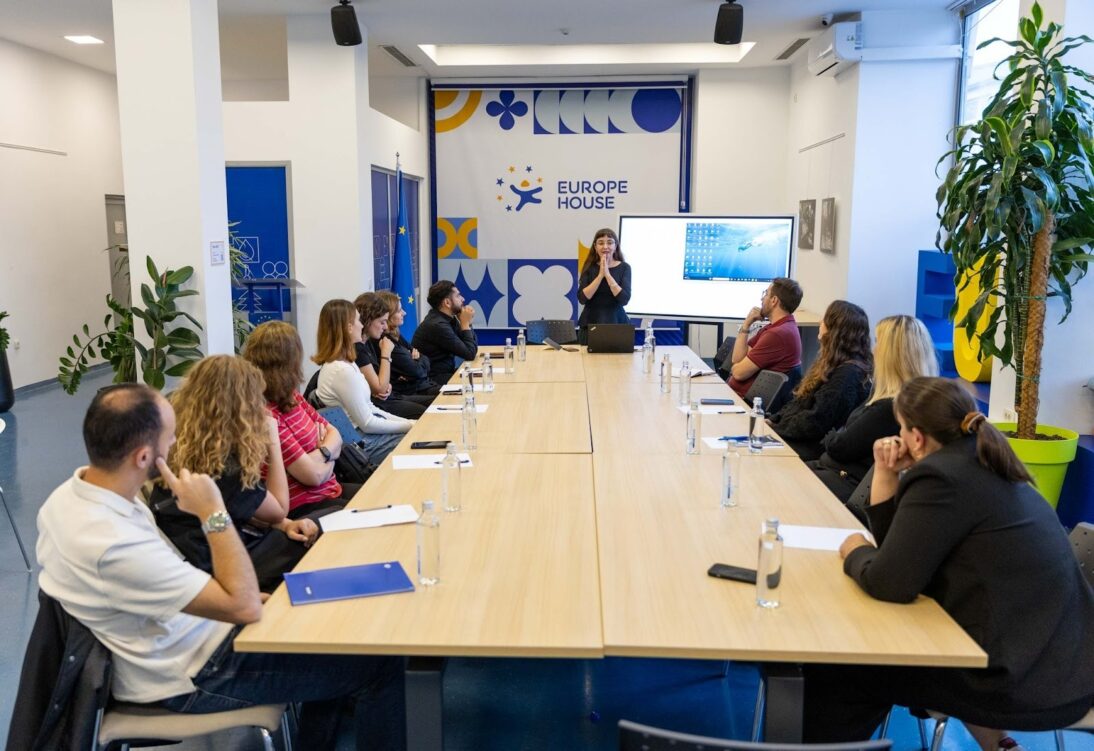
Europe House Kosovo: You are both a writer and an activist. Do you see sharing knowledge from your experience as part of the same mission? And what is one lesson you hope participants take with them?
Ervina Halili: Literary writing, in general, is a form of activism—but unlike social activism, it is symbolic and personal activism because it begins and finds its home in our personal imagination. In a philosophical sense, writing is an act of personal resistance. We are molded and developed as we try to adapt to circumstances that are already imposed upon us—be they psychological, cultural, or of any kind. As political beings, we are often involuntarily immersed in a ready-made system that may not harm us directly, but often suffocates our essential selves, alienates us, invalidates our values and our freedom.
I always try to show others how, through writing, they can create an environment in which they can live mentally free. And when they begin to live mentally and emotionally free, they gradually develop awareness of their social being, their social importance, and the self-censorship in which they live. So, to answer your question, yes—writing is not so different from social activism, but it carries a much deeper personal weight, where the individual becomes a symbolic voice of being—speaking from the source of freedom, from a world as it should be, and from circumstances that perhaps should have ended differently, even if they ended badly. Writing speaks through contrast and often through opposites. Sometimes, by depicting a difficult situation but expressing it emotionally in a literary way that speaks to others’ conscience, we reach a highly intelligent literary point: the ability to pose silent, submerged questions.
Europe House Kosovo: Have you tried to cultivate activist thinking among the participants—encouraging engagement with issues related to documentation and collective memory—especially given your ongoing effort to keep the discussion about Rilindja open?
Ervina Halili: As I mentioned earlier, I see writing as symbolic activism, whereas social activism has a completely different nature, even though I do not deny that the two can share common ground. For example, writing that can be read through a feminist lens contains both—it depends on the reader’s context and the era we live in. The same text will not speak to all individuals or all cultures in the same way. That’s the beauty of writing: it is not communicated only by the one who writes but also by the one who reads. Writing is both giver and receiver at once. This freedom makes it magical—not only on the level of experience but also of understanding.
Social activism has a more direct semantic nature. In my world, as an activist of documentation and archiving, I believe that everyone living a shared social life should possess the spirit of an activist. The world would be much more beautiful if it had more protectors—more active voices capable of turning their words into concrete practice.
Europe House Kosovo: If so, how do these practices of social engagement inform your writing? Does creative writing become a tool for addressing social issues—or conversely, do social efforts, yours or those of the communities you live in, inspire your creative impulse?
Ervina Halili: Yes, always—but, as I mentioned, on a symbolic level. I don’t believe literature can exist without external provocations. Yet literature is transformative: it takes something external and returns it no longer as an external thing. It passes it through an infinite, almost archetypal filter of the individual—through their voice, their personal experience, their dreams, traumas, complexes, knowledge, understanding, and experiences—and expresses it as something entirely unique, with layers far deeper than the event that inspired it.
That external event touches different points in each individual’s subconscious and memory. Society, by contrast, is more unified and collective; it holds shared ethical values. In literature, anything external that enters the literary world becomes a unique intellectual and emotional experience—it creates a personal ethic.
Europe House Kosovo: How do you transmit your personal impulse—whether emotional or social—into the form of creative writing, be it poetry or another genre? What is it like for you personally to transform something deeply personal into something political, something collectively shared, in a creative way?
Ervina Halili: As a process, I also dare to see it the other way around: how do we transform our social and political selves into beings of origin, stripped of every synthetic value—how do we undress ourselves? Over time, when writing becomes a way of life, it achieves this on its own, without you forcing it.
After a certain experience (and I don’t claim to have reached it fully), writing becomes a kind of guide—showing us how to gradually peel off all the layers of identity that are not truly ours, that have been imposed as the most suitable forms of survival. The beauty lies in being a political voice without political language, a social voice without activist rhetoric—letting the writing itself be the unique language that speaks through depths untouched by either the political or the social self.